

NASA issues a rare, high-priority notice, asteroid 2024 YR4 may heading toward a collision with the Moon in late 2032 unless corrective action is taken in time. Earth is comfortably out of danger now, but the Moon steadily moves into the line of fire as new calculations roll in.
A discovery that began as a routine end-of-year detection has transformed into an international test case for humanity’s growing planetary-defense abilities.
NASA’s latest assessment puts it bluntly “We have breathing room, but not forever. A lunar impact is now a realistic scenario.”
Moon at Risk: YR4’s Asteroid’s New Trajectory Data Raises NASA Concerns
YR4 is no cosmic speck. This object, roughly 53-67 meters across, is about as tall as modern apartment tower, the sort of rock capable of immense destruction if it ever struck Earth.
When astronomers picked it up on 27 December 2024, through Chile’s ATLAS survey, the earliest orbital readings looked nothing short of alarming.

- Initial Projections Delivered a Jolt –
- Earth Impact Odds – 3.1%
- Risk Level – Torino Scale 3, unusually high
But over the following weeks, improved measurements reshaped the threat landscape. Earth dropped off the danger sheet, yet the Moon drifted into a place of rising concern –
- Earth Strike Chance – Virtually Zero
- Moon Strike Chance – Creeping Upward Toward ~4%
That shift is why the tone around YR4 has changed so sharply.
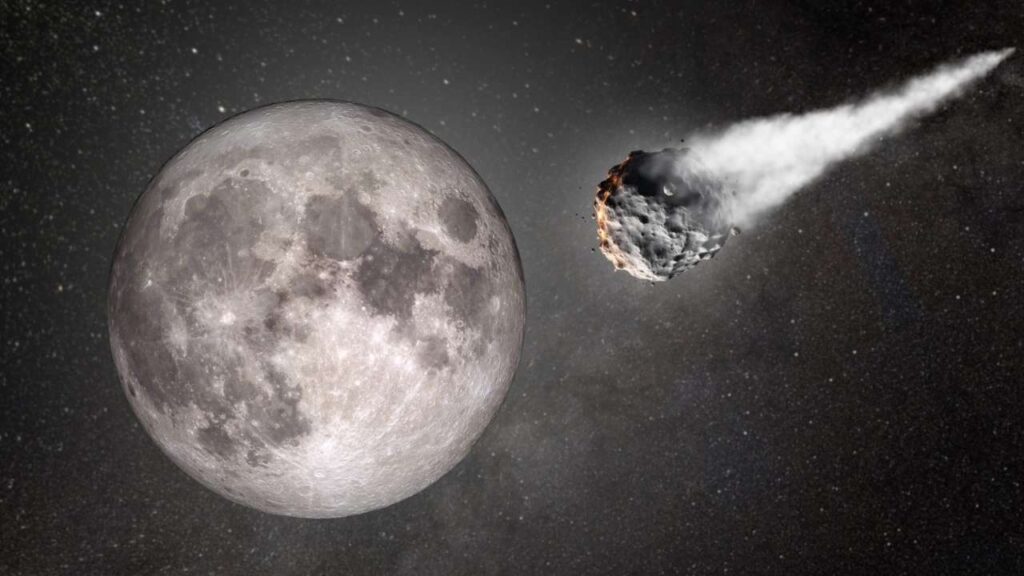
Why the Moon Remains at Risk While Earth Isn’t?
The Moon occupies a much narrower path through the uncertainty corridor of YR4’s orbit. While Earth benefits from a huge gravitational cross-section and the ability to safely “miss” by millions of miles, the Moon sits squarely in a zone where even tiny variations in the asteroid’s path can spell trouble.
Here’s what makes the Moon vulnerable –

- Small Trajectory Shifts Matter
- A few centimeters per second in velocity changes can nudge YR4 into a lunar intercept.
- No Air = Direct Hit
- The Moon has no atmosphere to burn away debris, everything arrives at full speed.
- Orbital Geometry Works Against It
- YR4’s approach intersects the Earth-Moon system in a way that lines up more neatly with lunar orbit than Earth’s.
The projected impact date sits around 22 December 2032, with the highest-probability zone located on the Moon’s near-side hemisphere.
Asteroid 2024 YR4 Key Details
| Details On | Asteroid 2024 YR4 |
| Diameter | 53-67 m |
| Earth impact risk | Essentially zero |
| Lunar impact risk | ~4% |
| Close approach year | 2032 |
| Discovery date | 27 Dec 2024 |
| Orbit type | Apollo NEO |
| Historical note | Brief leap to Torino 3 |
What Happens If YR4 Slams Into the Moon?
If YR4 slams into the lunar surface, the results would spectacular from a scientific perspective and chaotic for spacecraft.
- Predicted Consequences Include –
- Energy Blast – Roughly 6 – 7 megatons.
- Impact Crater – Close to 1 km wide.
- Lunar Ejecta – Tens of millions of kilograms kicked into space.
- Debris Speed – Fast enough to escape the Moon entirely.
Here’s the Part That Spikes Concern –
A chunk of that debris could drift into near-Earth space within days. This isn’t dangerous to people on the ground, but for satellites? Not ideal, not even slightly.
Possible Satellite Issues –

- Abrasion and micro-punctures
- Sensor damage
- Orbit destabilization
- Shortened operational life
- Elevated risk for crewed missions around the Moon and Earth
One researcher described the scenario as “A temporary, artificial meteor shower targeted at our space hardware.”
From Discovery to Alarm Bells: Key Dates
| Event & Finding | Timeline / Date to Know |
| ATLAS identifies YR4. Size estimates range widely. | 27, December 2024 |
| Early models show a non-trivial Earth strike probability. | January 2025 |
| Risk plummets as new data rolls in; moon begins to look vulnerable. | 25, February 2025 |
| JWST refines the asteroid’s diameter and thermal profile. | 26, March 2025 |
| YR4 disappears behind the Sun, leaving astronomers with limited new data until 2028. | April 2025 |
| The key year, when the Moon may take a hit if nothing changes. | 2032 |
NASA Considers Pushing Asteroid Off Course
Even with a low probability, NASA’s strategy is shifting from “monitor closely” to “prepare options.” Deflecting an asteroid aiming at the Moon is far simpler than handling one aimed at Earth; the margin for success is wider and the consequences of inaction are avoidable.
Right Now, Only Two Technologies Make Sense –
- 1. Kinetic Impactor
- A spacecraft slams into the asteroid, slightly altering its momentum. (DART proved this works well.)
- 2. Nuclear Standoff Detonation
- A controlled blast nearby adjusts the asteroid’s trajectory without breaking it into hazardous fragments.
Both require several years of lead time, meaning decisions must be made before 2030-31.
Why a Lunar Strike Matters More in the 2030s?
The Moon is no longer an empty ball of rock we only visit in documentaries. By the 2030s, cislunar space will be bustling –

- Lunar Gateway
- Artemis base modules
- Commercial landers
- Navigation relays
- Communication satellites
- Resource-mapping robots
- Future mining missions
- A major lunar impact could disrupt all of that.
As one analyst put it “A strike on the Moon is now a strike on our infrastructure.”
A New Era For Planetary Protection Begins
The YR4 situation highlights a bigger shift; Planetary defense is no longer just about avoiding extinction-level impacts. It’s evolving into the protection of our entire space ecosystem.
- NASA’s PDCO, Since Its Creation in 2016 Task With –
- Tracking hazardous NEOs
- Coordinating with global agencies
- Studying deflection engineering
- Running scenario simulations
- Managing public advisories
With tens of thousands of near-Earth objects cataloged and many more lurking unseen, the system is more important than ever.
2028: The Year That Will Decide Everything
The next window to observe YR4 clearly opens in 2028 and that year will decide everything.

Three Outcomes Are Possible
- Trajectory Moves Away From Moon – The risk evaporates.
- Probability Spikes – A deflection mission becomes virtually guaranteed.
- Data Stays Ambiguous – NASA must weigh cost vs. caution carefully.
Until then, YR4 stands as a reminder – Space isn’t just a frontier, it’s a responsibility. And for the first time, our biggest concern may not protecting Earth… but safeguarding the growing human presence beyond it.