

Mars keeps staring back at NASA, almost daring scientists to decode it. Why does a frozen, dusty planet hide so many surprises beneath its red shell? Every mission returns with deeper questions than answers.
Because under that rugged crust lies buried ice; silent, ancient, impossible to ignore. How did so much frozen water survive on a world that looks lifeless? NASA suspects Mars is holding onto forgotten chapters of its past.
Then there’s Olympus Mons, the giant that refuses to be explained. A volcano three times taller than Everest on a supposedly quiet planet; how did such a monster ever form, and why did it stop?
Ice below, extinct fire above, how can one planet hold such contradictions? NASA keeps chasing clues, convinced Mars isn’t just another world, but a mystery engineered to keep humanity asking the same question: what else lies hidden?
Red Planet Mysteries Deepen With New Discoveries
Recent analyses reveal that Mars hides substantial ice reserves beneath its dusty terrain, prompting NASA to rethink the planet’s past water activity. Meanwhile, radar scans suggest frozen layers as thick as a mountain base, fueling renewed exploration efforts.
On the surface, Mars still astonishes; colossal volcanoes like Olympus Mons dominate the landscape, while vast canyons stretch thousands of kilometers. These features, along with hidden seasonal flows and ancient lakebeds, continue to puzzle scientists, challenging longstanding assumptions about Martian history.

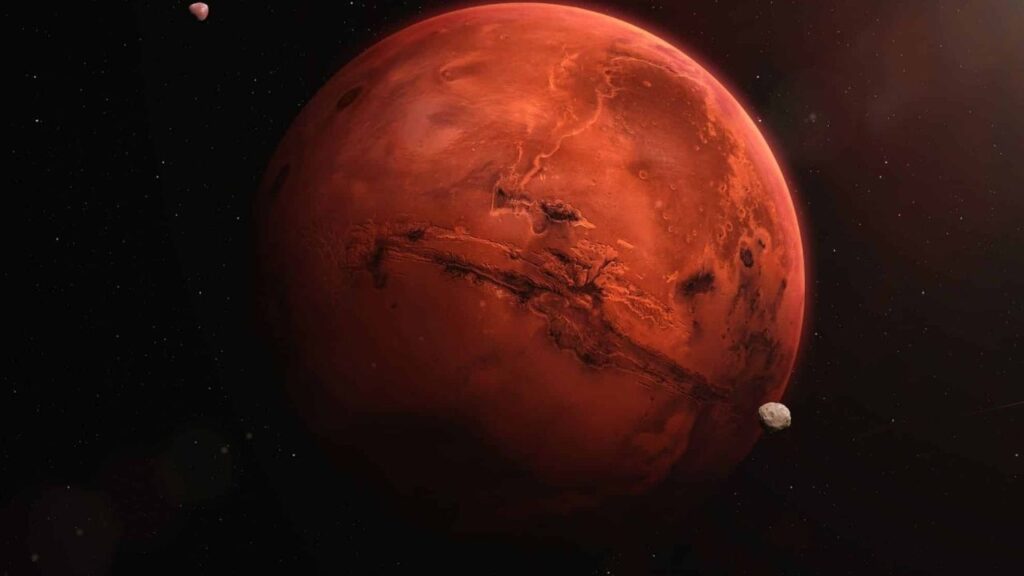
Mars Keeps Changing the Story With Every Scan
Mars looks like a frozen desert from afar, but the closer NASA gets, the stranger the place becomes. Windstorms carve dunes the size of cities.
Dust rises into planet-wide hazes. And beneath all that rusty soil lies water-ice; not pools, not oceans, but vast sheets waiting to be understood.
- Key Facts From NASA’s Latest Mars Research
- Cold, dry, dusty surface with a whisper-thin atmosphere.
- Ice locked under soil near the poles.
- Gigantic extinct volcanoes, ancient canyons, and wind-shaped plains.
- Rovers have found evidence Mars once had warm lakes and rivers.
- NASA still doesn’t know exactly how or when; Mars lost its thicker, life-friendly atmosphere.
The Surprising History Behind Mars’ Name
The name “Mars” didn’t come from scientists, it came from ancient sky-watchers. Romans saw its reddish glow and linked it to the god of war. Egyptians called it “Her Desher,” the red one.
Today we still call it the Red Planet, even though the ground is actually a mix of gold, tan, and brown. The red tint comes from iron-rich dust oxidizing, basically turning to rust and spreading across its atmosphere like cosmic makeup powder.
Proof of Past Life? Mars Keeps Dropping Hints
NASA isn’t expecting to find Martian creatures strolling between boulders. The real hope lies in the past. Every rover landing since the early 2000s has uncovered clues that billions of years ago, Mars was dramatically different; warmer, wetter, coated with lakes, streams, and possibly oceans.

NASA Zeroes In on Red Planet’s Hidden Clues
- Ancient rocks carrying chemical fingerprints of past water
- Minerals that only form in warm, wet environments
- Sediment layers that look eerily similar to Earth’s lakebeds
- Microscopic textures inside stones that may hint at past microbes
Mars may dead now, but its past still whispers possibilities.
A Smaller World With a Big Personality
Mars is only half Earth’s size, but its land area nearly matches all the continents on our planet combined. That’s because Mars doesn’t have oceans, just dry soil stretching for thousands of miles.
A Quick Look at Its Stats
| Feature | Mars | Earth |
|---|---|---|
| Radius | 3,390 km | 6,371 km |
| Atmosphere | Thin, mostly CO₂ | Thick, nitrogen-rich |
| Day Length | 24.6 hours | 23.9 hours |
| Year Length | 687 Earth days | 365 days |
| Temperature Range | 20°C to -153°C | Roughly -89°C to 57°C |
Mars is small, sharp, and harsh; but familiar enough to make every discovery feel strangely personal.
The Rhythm of a Martian Year
Mars spins almost like Earth, slightly slower, giving it a 24.6-hour day called a “sol.” But its journey around the Sun is stretched and uneven. Seasons are long, lopsided, and unpredictable.
Mars’ Seasonal Breakdown
- Northern Spring / Southern Autumn – ~194 sols, the longest.
- Northern Summer / Southern Winter – ~178 sols
- Northern Winter / Southern Summer – ~154 sols
- Northern Autumn / Southern Spring – ~142 sols, the shortest.
Mars’ seasons stretch out because its orbit is more egg-shaped than Earth’s. When Mars swings closer to the Sun, everything heats up. When it swings out, it freezes hard.

Two Moons That Look More Like Asteroids
Instead of round moons like ours, Mars has two lumpy companions; Phobos and Deimos. Both appear more captured than created, odd rocks pulled in by Mars’ gravity long ago.
Phobos
- Larger, pockmarked with deep grooves.
- Spiraling toward Mars.
- Will smash into the surface or crumble into a ring in ~50 million years.
Deimos
- Smaller and more distant.
- Covered in smooth dust.
- Looks like a drifting space pebble.
If Phobos does break apart, Mars may briefly become a ringed planet, a cosmic makeover millions of years in the future.
A Planet Built in Layers
Mars formed about 4.5 billion years ago from the swirl of early solar system dust. The planet ended up with three primary layers:
- Core – Iron, nickel, sulfur.
- Mantle – Rocky interior that once fueled volcanic activity.
- Crust – Iron-heavy, mineral-rich surface.
Mars’ crust holds hints of its lost magnetic field; a protective bubble it once had, but somehow lost. Without it, Mars’ atmosphere slowly peeled away into space.
Landscapes That Redefine “Extreme”
You want extremes? Mars delivers.

Valles Marineris – The Canyon That Shouldn’t Exist
A canyon so long it could stretch from California to New York.
- 4,800 km long
- 320 km wide
- 7 km deep
It makes Earth’s Grand Canyon look like a crack in dry mud.
Olympus Mons – The King of All Volcanoes
- Three times taller than Everest
- Base the size of New Mexico
- So massive its slopes are gentle, you could walk up them without noticing the incline
This volcano is extinct, but it proves Mars once had a hot, active interior.
Water Was Everywhere – Until It Vanished
Millions of years ago, water rushed across the surface, filling lakes and carving ancient river valleys. Rovers have captured pictures of rounded pebbles, rippled sediments, and minerals that only form underwater.
Today, Mars holds –

- Frozen water beneath the soil
- Polar ice caps
- Briny, salty flows that appear seasonally
The question remains; Where did all the water go? Some escaped into space. Some froze. Some is still hidden. NASA wants to find the rest.
A Thin Atmosphere That Can’t Hold Heat
Mars’ atmosphere is mostly carbon dioxide, with a sprinkle of nitrogen and argon. Thin, cold, and dusty, it fails to protect the planet from meteorites or retain warmth.
Dust storms can wrap the entire planet in a red haze for months. Temperatures go wild, warm at your feet and freezing at your head. It’s a world of contradictions.
A Ghost of a Magnetic Field
Mars once had a global magnetic field, but now only patches of its southern crust hold traces of magnetism. Without protection, solar wind stripped the atmosphere away.
It was the great turning point in the planet’s history, the moment Mars began becoming the cold desert we know today.
Still a Mystery, Still Worth the Chase
With all the maps, photos, rovers, orbiters, landers, and decades of exploration, Mars still holds back its deepest secrets. That, more than anything, is why NASA keeps going back.
Every sample, every grain of dust, every seismic tremor recorded by a lander is a clue. Mars isn’t done talking and humanity isn’t done listening.