

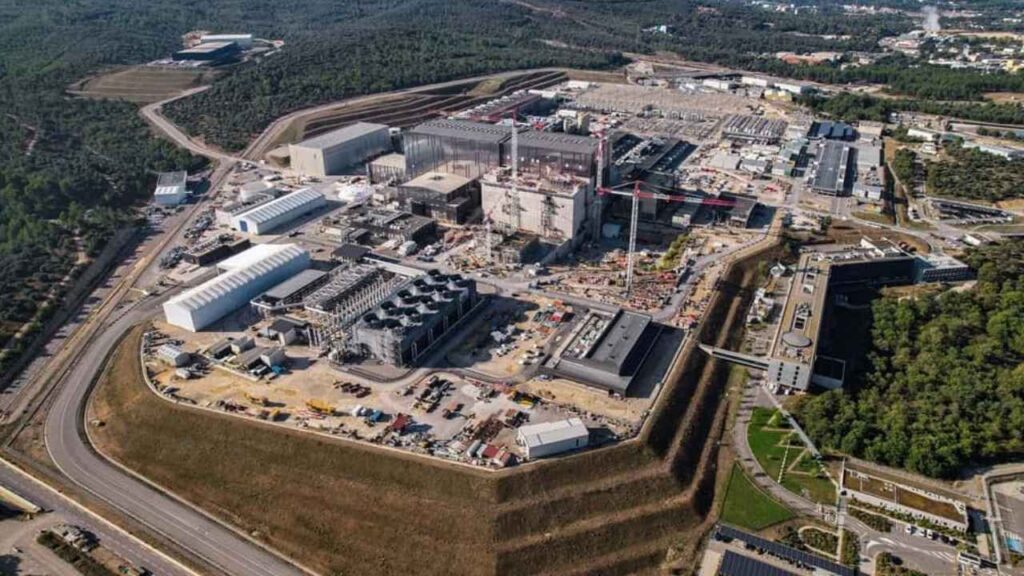
The global energy map is tilting in a new direction as the world quietly prepares for life beyond oil. Deep in southern France, the ITER fusion machine is stepping into a construction phase that could redefine modern power generation.
For decades, fusion research moved slowly, restricted by complex engineering and political delays. Now, the project has reached a moment where ideas are turning into hardware, and hardware is moving into final assembly. Fusion energy is shifting from a scientific aspiration to a near-term technological milestone.
Many researchers call this chapter a turning point. The past century belonged to fossil fuels, but the next century may belong to fusion, a process that mirrors the inner workings of stars and offers energy on a scale oil cannot provide.
Fusion promises something the world has never had before: clean power with enormous output, steady availability, and a virtually endless fuel supply. ITER is the gateway to that reality.
A New Energy Dawn: ITER Marches Into Its Defining Phase
ITER enters its most crucial build stage, locking massive reactor pieces into place and pulling global attention back to fusion. Each new assembly milestone intensifies the sense that humanity is inching toward a real, irreversible goodbye to oil dependence.
Fresh global commitments and rising fusion breakthroughs add suspense to ITER’s journey, even as its full power timeline stretches into late 2030s. The emotional weight is unmistakable; if ITER succeeds, limitless clean energy could finally break the chains of pollution, scarcity, and fossil-fuel vulnerability.

Fusion’s Rising Fame: What Triggered It?
Global energy demand is climbing rapidly, while environmental pressures demand cleaner alternatives. Nations are searching for sources that can deliver stability without harming the climate or relying on volatile markets.
Fusion stands apart because it does not depend on unpredictable weather, limited natural reserves, or politically sensitive supply chains. It promises uninterrupted power for industries, cities, and future technologies.
The fuels used in fusion, mainly deuterium from seawater and tritium bred from lithium, exist in huge quantities. This means humanity is not looking at decades of supply but thousands of years.
Inside the Fusion Engine: How ITER Works?
Fusion happens when two light atomic nuclei collide and merge, releasing a burst of energy. It is the same mechanism that lights up the Sun, but ITER attempts it inside a controlled magnetic vessel known as a tokamak.
To succeed, ITER must warm hydrogen plasma to about one hundred and fifty million degrees Celsius. At this temperature, particles move fast enough to fuse. Because no structure can handle that heat, magnetic fields shape and hold the plasma in mid-air.

Producing stable plasma requires intense precision, exceptional cooling, and advanced superconducting magnets. The core reaction follows this path –
- Deuterium plus tritium.
- Formation of helium and a high energy neutron.
- Surplus energy released from the collision.
ITER in One Quick Snapshot
| Feature | Description |
|---|---|
| Site | Saint Paul les Durance, southern France |
| Mission | Demonstrate large scale fusion power generation |
| Plasma Temperature Target | Around 150 million degrees Celsius |
| Magnetic Coils | Superconducting, operating at ultra low temperatures |
| Participating Members | Thirty three countries |
| Outcome Goal | Prove fusion can produce more power than it consumes |
A Worldwide Collaboration With One Goal
ITER is not a national project but a global one. Thirty three participating nations contribute components, designs, expertise, and scientific teams. The shared mission reflects how essential fusion is to humanity’s long term stability.
Major Partners Include –
- European Union
- India
- Japan
- China
- South Korea
- Russia
- United States
This level of cooperation is rare in modern geopolitics. The fact that so many nations work together on one machine shows how fusion has become a universal priority.
The Most Delicate Chapter in ITER’s Journey
After years of preparing foundations and manufacturing parts, ITER is now assembling the core regions of the tokamak. This includes heavy steel vessel sectors, cryogenic cooling systems, magnetic coils, and high frequency heating tools.
Westinghouse Electric Company recently began assembling key structural sections that form the inner shell of the machine. These curved steel sectors are essential for containing the fusion environment and anchoring the magnetic systems.

This period marks the most delicate stage yet. Every component must be aligned with remarkable accuracy. A small misplacement could destabilize plasma or weaken magnetic confinement.
The structural loads inside ITER will among the strongest in civilian engineering, demanding absolute perfection.
Oil vs Fusion: The Clear Winner
Oil dominated global markets, transportation systems, and geopolitics for more than a century. But its environmental cost and supply limitations have pushed nations to seek new options.
Fusion resolves nearly every shortcoming of fossil fuels –
- No carbon emissions.
- No smoke, soot, or hazardous fumes.
- No large scale radioactive waste.
- No risk of catastrophic meltdown.
- Tiny fuel quantities required.
- Long term abundance of raw materials.
Oil extraction, refinement, and transport involve logistical risks, pollution, and accidents. Fusion requires only trace amounts of fuel extracted from seawater and lithium, both easily accessible.

Here is a Straightforward Comparison –
| Attribute | Oil | Fusion |
|---|---|---|
| Pollution Level | High | Extremely Low |
| Fuel Security | Vulnerable to shortages | Abundant for thousands of years |
| Safety | Fires, spills, and leaks | No meltdown path |
| Waste | Toxic byproducts | Minimal and short lived |
| Energy Yield | Moderate | Exceptionally high |
Inside ITER’s Master Plan
ITER’s mission extends well beyond producing plasma. The project intends to validate technologies that future commercial fusion reactors will depend on.
Its Primary Targets Include –
- Generating around five hundred megawatts of fusion energy.
- Achieving ten times more output than input power.
- Sustaining long running plasma operations.
- Testing systems that breed tritium fuel.
- Demonstrating consistent magnetic stability.
- Laying groundwork for next generation fusion plants.
These goals form the foundation for DEMO, the planned commercial scale fusion facility expected to follow ITER.
A Slower Timeline, a Smarter Strategy
ITER recently revised its schedule to prioritize a more complete machine before plasma experiments begin. While this adjustment adds time, it significantly improves the probability of long term success.
Instead of chasing symbolic milestones, ITER now focuses on building a durable, high performance system ready for decades of experimentation.

Upcoming Milestones Include –
- Closure of the cryostat in 2033
- Full system commissioning by 2034
- Initial research operations in 2034
- Maximum magnetic power test in 2036
- Fusion operations with deuterium and tritium in 2039
A Glimpse of a Fusion Powered World
If fusion becomes commercially viable, the impact will reach beyond electricity generation. It could reshape economies, inspire new industries, and ease geopolitical tensions linked to fuel competition.
A world powered by fusion could see fewer emissions, steadier energy prices, and improved public health. Cities would expand without fear of energy shortages. Industries could operate with clean, high density power.
Most importantly, nations would not need to compete for fossil resources. Fusion could bring energy independence to nearly every region on Earth.
The Birth of a Clean Energy Era
ITER’s transition into its decisive construction stage represents a historic moment for global science. The project is edging humanity closer to a future where oil no longer dictates economic strength or environmental fate.
The challenges remain significant, but the momentum is unmistakable. Fossil fuels shaped the last hundred years. Fusion has the potential to shape the next thousand.